Fungal nail symptoms: how to spot it early
 Peter Boeters 15 min read
You’re looking down at your toenail and something isn’t right. An edge that’s a little more yellow than last month. A patch that looks duller than the rest. It might be nothing. It might also be one of the first fungal nail symptoms. And as with most things on your feet, the sooner you know what you’re looking at, the less effort it takes later.
In this article you’ll read what a fungal nail looks like, why the early signs so often go unnoticed, what else a thick or discoloured nail can be, and what a sensible approach looks like when there really is a fungal infection underneath.
The short version
- The three signs of a fungal nail are discolouration, thickening and a crumbly or rough texture.
- Fungal nail infections are common, especially later in life.
- Fungal nail, nail fungus, toenail fungus: different names, one condition. A fungus is by far the most common cause of a thick, discoloured nail, but not the only one.
- A nail grows about 1 mm every 6 weeks. Think months, not weeks.
- What helps most is looking after the nail, the skin around it, your shoes and your daily habits together.
What is a fungal nail?
A fungal nail is a nail that has changed colour or texture because of a fungal infection in the nail plate, known medically as onychomycosis. It’s one of the most common nail problems there is, and it usually affects the toenails. If you want the full background, read what a fungal nail infection is.
The infection usually starts at the edge of the nail or under its free edge, where the fungus has room to grow into the nail material. The HSE describes the same pattern: it often begins at the edges and then spreads to the middle. Dermatophytes are the best-known cause, but yeasts and other fungi can produce the same picture. Once the fungus is in, it grows along with the nail and becomes part of the nail plate itself.
That explains why buffing, filing or a coat of nail varnish doesn’t get rid of the discolouration. The fungus isn’t on top of the nail, it’s inside it. And that’s exactly why it doesn’t go away by itself. A fungal nail doesn’t clear up without treatment, and over time it often spreads to other nails or to the skin around it.
Fungal nail symptoms: the three signs to look for
Almost every fungal nail can be recognised by three features. Sometimes all three at once, sometimes one clear sign and two subtle ones. When two or three come together on the same nail, it’s very likely no coincidence. The NHS lists the same symptoms: a nail that’s discoloured, thicker than usual, and brittle or crumbly. What we see time and again is that most people only act at the third sign. By then the nail is further affected than it needed to be.
Discolouration of the nail
The colour changes. That rarely happens in one step from pink to dark. Early on you often see a dull patch, a streak that looks whiter than the rest, or a yellow edge along the side or under the free edge. As the infection spreads, the colour deepens: off-white, yellow-brown, sometimes greenish or almost black where hardened material builds up under the nail.
Check whether the colour will wash off. Dirt or nicotine stains disappear with soap. The colour of a fungal nail stays, because it’s in the material of the nail itself. That’s a useful test you can do at home, before you ask anyone to look at it.
Thickening of the nail
A healthy toenail is clear and fairly flat. A fungal nail gets thicker, often bumpy, and harder to cut. You notice it when your clippers struggle to get through, or when the nail starts rubbing against the top of your shoe even though it isn’t too long.
The thickening happens because the nail bed builds up extra keratin in response to the infection. In principle it’s a defence. But that extra layer also makes it harder to reach the fungus, which is why a thick nail often needs thinning by a podiatrist before anything you apply can get far enough.
A crumbly or rough texture
The third sign is texture. The nail no longer feels smooth. It flakes at the edges, crumbles under the clippers or gives off a fine, dusty powder when you file it. Sometimes you’ll see crumbly material under the nail, which means the nail plate is lifting away from the nail bed (onycholysis, in medical terms).
For many people, this is the moment they finally do something. Discolouration hides under a sock. Thickening you only notice in narrow shoes. But a nail that crumbles away is hard to ignore, and a lot of people tell us this was the sign that made them realise it needed more than a home remedy.
One condition, many names
If you’ve been searching online, you’ll have seen a handful of names. Fungal nail, fungal nail infection, nail fungus and toenail fungus all mean the same thing. Doctors call it onychomycosis, and when it’s caused by a dermatophyte you may also see tinea unguium. Different words, one condition: a fungus growing in the nail plate.
We’re a Dutch brand, and in the Netherlands the everyday name is kalknagel, which means “chalk nail”. It has nothing to do with calcium or chalk deposits. The name simply describes the look: a nail that turns white or yellow and goes powdery, as if there’s a chalky residue on it.
What does matter is that not every thick or discoloured nail is a fungal one. A nail that was once crushed or stubbed, nail psoriasis, years of pressure from tight shoes or running, or a bruise under the nail can all look similar. A black toenail after a knock is usually a bruise: it grows out with the nail and disappears over time, and a fungal infection doesn’t. We explain how to tell these apart in our article on the question what is a fungal nail infection?
That difference matters for what you do next. Products for fungal nails, tiptoe naildrops included, aren’t meant for nails affected by psoriasis, for example.
You can’t tell for sure by eye. To be certain, your GP can take a nail sample and send it to a lab. Our free nail test gives you a first idea in a few minutes. It’s a self-check, not a diagnosis.
What happens if you wait
A fungal nail isn’t something that goes away by itself. Quite the opposite: without treatment, the fungus spreads. First through the rest of the same nail, then to the toes next to it, and sometimes to the skin under and between your toes. What starts as a yellow edge on one nail can be four affected nails two years later.
The bigger the affected area, the longer the way back. A nail grows about 1 mm every 6 weeks, so think months, not weeks. A treatment can deal with the fungus, but nothing can make a nail grow faster than its own pace. If you wait until half the nail is affected, you literally have more nail to grow out than someone who acts at the first sign of discolouration.
On top of that, a thick, affected nail is more likely to split, lift or grow in. If you have diabetes or poor circulation, that can lead to infections. The NHS advises seeing a GP if you have diabetes or a weakened immune system. Acting early isn’t just about how your nail looks. It also helps you avoid problems that come after.
Home remedies for fungal nails
Vinegar, tea tree oil, Vicks VapoRub, toothpaste, baking soda, garlic. The list of home remedies for fungal nails is a long one. Plenty of the people we speak to have tried at least three. Here’s where things stand, briefly.
Vinegar slightly slows fungal growth in lab conditions, because it’s acidic. On a thick, hardened nail it doesn’t get deep enough to reach the fungus in the nail plate. A vinegar foot soak often feels fresher for a while, but it won’t clear a fungal nail.
Tea tree oil has had more serious research than any other home remedy. In the lab it acts against fungi. But the concentrations used in studies are higher than what you’ll find in a bottle from the chemist, and here too the thick nail is the limiting factor: it has to get through.
Vicks VapoRub contains menthol and eucalyptus oil and wasn’t developed for nail infections. A small study from 2011 showed improvement in some of the participants, but the set-up was limited and the results have never been confirmed on a large scale.
Toothpaste, baking soda, garlic. None of these has any proven effect on onychomycosis. They can irritate or dry out your skin without touching the cause.
The common thread: every home remedy runs into the same problem. The fungus is in the nail, not on it. Without a way to get an active ingredient through the nail plate, the infection is left alone.
How to treat a fungal nail
Once you know it’s a fungal nail, there are a few routes, and our guide to fungal nail treatment goes through them in detail. In the UK and Ireland the usual first stop is a pharmacist, who can suggest a medicated nail lacquer or paint that you apply daily or weekly, often for 6 to 12 months. These aren’t suitable for everyone: the NHS says they’re not for under-18s or if you’re pregnant or breastfeeding.
If it’s severe, has spread or doesn’t improve, your GP can take a nail sample and may prescribe tablets, usually for up to 6 months. Tablets need blood tests to check your liver and aren’t suitable for everyone. Badly infected nails are sometimes removed under local anaesthetic. Some private clinics also offer laser treatment or photodynamic therapy, where a special gel is combined with light.
If you’d rather look after it yourself with a daily routine at home, that’s where tiptoe fits in. You apply tiptoe naildrops twice a day at the base of the nail, where new nail grows, in the morning and in the evening. It takes a few minutes a day. The drops contain a patented peptide, and scientific publications have been written about it. Results vary from person to person and depend on how deep the infection goes.
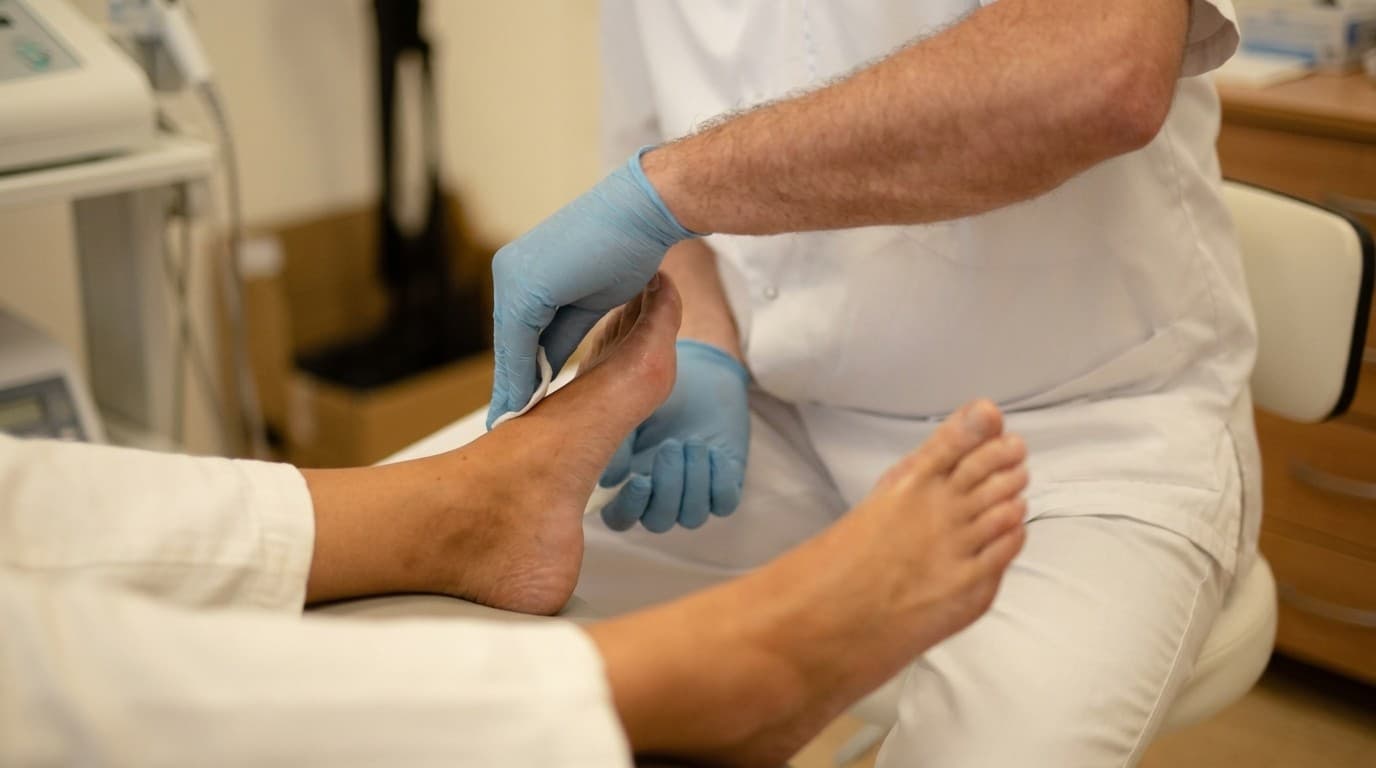
Whatever you choose, a thick nail is the hurdle. A podiatrist can thin the top layer first. That isn’t a cosmetic step: it helps whatever you apply, home remedy or medicine, get closer to where the infection sits. On a very thick nail, not much gets deep enough without it.
A complete approach: nail, skin and shoes
A common mistake with fungal nails is focusing on the nail alone. But the fungus also lives on the skin of your foot and in the shoes that foot sits in every day. A fungal nail often comes back because only the nail gets treated, while the skin between the toes and the shoes reinfect it.
That’s why the tiptoe routine looks at the whole foot. Three steps that work together:
- tiptoe naildrops for the nail itself. You apply the drops every day at the base of the nail, where new nail grows.
- tiptoe care foam for the skin around the nail and between your toes. It cares for the skin where reinfection often starts. Leave the skin out, and you can end up back at square one just as the nail grows out.
- tiptoe protect your feet for your feet and shoes. A ready-to-use spray, so you don’t reinfect yourself. Fungal spores can survive in shoes for months.
The combination isn’t random. Each step covers one of the places where the fungus can hold on. Results vary from person to person and depend on how deep the infection goes.
How to prevent fungal nails
Preventing fungal nails comes down to one principle: fungi love warmth, moisture and the dark. Every habit that takes one of those away lowers your risk. In practice, that means a handful of daily habits, and our complete guide to preventing fungal nails covers them all.
Dry your feet properly after a shower or a swim, especially between your toes. Moisture that stays behind is an open invitation for a fungus. Most of us wear shoes every day, often the same pair. Where you can, alternate at least two pairs so each one gets the chance to dry out completely. Choose socks made of breathable material (cotton, wool or bamboo) and avoid synthetic socks if your feet sweat a lot.
Don’t walk barefoot in public places where lots of other people do: gym showers, changing rooms, swimming pools. Flip-flops or pool sliders take most of that risk away. Keep your nails short and cut straight across, without sharp corners that catch on your socks and damage the edge of the nail. The NHS adds two more: treat athlete’s foot promptly, and don’t share towels, shoes or nail tools.
If you know you’re prone to it (you’ve had a fungal nail before, you have diabetes or athlete’s foot, or someone at home has a fungal infection), make tiptoe protect your feet part of your daily routine, so you don’t reinfect yourself. Prevention takes minutes a week. Treatment takes months.
Frequently asked questions about fungal nails
How can I be sure it’s a fungal nail and not something else?
You can’t be completely sure by eye. If you spot all three signs at once (discolouration, thickening and a crumbly texture), that’s a strong hint. To confirm it, your GP can take a nail sample and send it to a lab. Our free nail test gives you a first idea, but it’s a self-check, not a diagnosis.
Are fungal nails contagious?
The fungus can pass on via damp surfaces: shower floors, shared towels, someone else’s shoes. From skin to skin, the risk is smaller. On your own body it spreads more easily, from nail to nail or from your foot to your groin, which is why looking after the whole foot matters. Read more in is a fungal nail infection contagious?
Can I treat a fungal nail myself?
If it’s early (some discolouration, not much thickening), you can often start at home, with a medicated nail lacquer from a pharmacist or a consistent daily routine. Once the nail gets thicker or starts to crumble, it usually needs thinning so whatever you apply can reach the right spot. That’s a job for a podiatrist.
How long does it take for a fungal nail to grow out?
Any visible change follows the growth of the nail. A nail grows about 1 mm every 6 weeks, so think months, not weeks. A big toenail takes more than a year to be fully replaced. How long it takes for you depends on how deep the infection goes.
Can a fungal nail come back?
Yes, especially if the skin and your shoes aren’t looked after as well. That’s why we look at the nail, the skin and your shoes as one. Keep up the habits afterwards: dry feet, alternating shoes, flip-flops in communal showers, and a spray for your feet and shoes such as tiptoe protect your feet.
Can older people or people on medication use tiptoe?
Older people can use the drops, and so can people who take medication. They’re for external use only and aren’t meant for nails affected by psoriasis. For a child, or if you have diabetes, check with your GP first.
To sum up
Fungal nails are stubborn, but rarely a mystery. Once you recognise the three signs (discolouration, thickening and a crumbly texture), you know when it’s time to do something. The rest is patience, an approach that includes the whole foot, and the willingness to keep going for as long as the nail needs to grow out.
Not sure whether what you’re seeing is a fungal nail? Take the free nail test, or ask your GP or a podiatrist to take a look. First find out what you’ve got, then decide what to do about it.
Frequently asked questions
How can I be sure it’s a fungal nail and not something else?
You can’t be completely sure by eye. If you spot all three signs at once (discolouration, thickening and a crumbly texture), that’s a strong hint. To confirm it, your GP can take a nail sample and send it to a lab. Our free nail test gives you a first idea, but it’s a self-check, not a diagnosis.
Are fungal nails contagious?
The fungus can pass on via damp surfaces: shower floors, shared towels, someone else’s shoes. From skin to skin, the risk is smaller. On your own body it spreads more easily, from nail to nail or from your foot to your groin, which is why looking after the whole foot matters.
Can I treat a fungal nail myself?
If it’s early (some discolouration, not much thickening), you can often start at home, with a medicated nail lacquer from a pharmacist or a consistent daily routine. Once the nail gets thicker or starts to crumble, it usually needs thinning so whatever you apply can reach the right spot. That’s a job for a podiatrist.
How long does it take for a fungal nail to grow out?
Any visible change follows the growth of the nail. A nail grows about 1 mm every 6 weeks, so think months, not weeks. A big toenail takes more than a year to be fully replaced. How long it takes for you depends on how deep the infection goes.
Can a fungal nail come back?
Yes, especially if the skin and your shoes aren’t looked after as well. That’s why we look at the nail, the skin and your shoes as one. Keep up the habits afterwards: dry feet, alternating shoes, flip-flops in communal showers, and a spray for your feet and shoes such as tiptoe protect your feet.
Can older people or people on medication use tiptoe?
Older people can use the drops, and so can people who take medication. They’re for external use only and aren’t meant for nails affected by psoriasis. For a child, or if you have diabetes, check with your GP first.